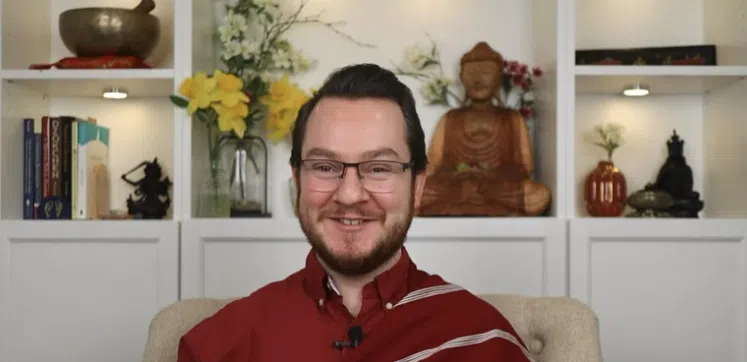
Sunday morning Meditation 16th March 2025
Teachings
Well, for this morning’s talk or reflection, I thought we could reflect on the Buddhist teaching that we all essentially have within us a basic goodness.
Sometimes, of course, what we refer to as our Buddha nature or our enlightened nature.
And essentially the idea being that all the confusion, the delusion, the anger, the hatred, the miserliness, the jealousy are all adventitious, temporary afflictions, arisings, temporary arisings. They arise, they pass.
They’re not inherently a part of who we are or our nature, if you like, our being. Because they change, right? We don’t just feel one kind of way.
We’re not just always angry, always stressy- although it might feel like that sometimes. There are times without it, it’s not just one way that we feel. And so these feelings and these emotions, whether afflictions or not, cannot be fundamental to who we are. Because our thoughts also change: as we saw in that meditation, they arise and they pass. We don’t just think one kind of thought for our entire life. They change. And so we recognise they also cannot be fundamental to our being.
But the Buddha discovered for himself through his practice, through his awakening, that we are, beneath it all, essentially, fundamentally, basically good. And that this goodness is not something that is created, and it’s not something that’s imagined, it’s not something that we develop even. It is the heart or the essence inherent in all living beings or sentient beings. Our true nature is wisdom; it is boundless, limitless, immeasurable love and kindness and compassion; it is a profound wellbeing. It’s a joy.
The issue, of course, is that we just don’t recognise it yet. It is there. But if it is there, if it is our essential nature, why do we behave in ways that are so antithetical to wisdom and immeasurable love and compassion? Why is it that we don’t behave out of this basic goodness? What is wrong? What’s the issue?
Or we could compare this basic nature, this Buddha nature, to the sun, as we did there. In that meditation, though, it is always shining. But the sun is often obscured by the clouds, right? And then the clouds are our conditioning, our misunderstandings, our way of grasping onto self and other, as inherently existent or inherently real, right from their own side. From which sparks attraction and aversion in which we pull some things towards us; we have craving, we desire some things in our life, and we push away other things. And we don’t want those in our life, that sort of push and pull of life.
And so the clouds are all of the afflictions, greed, hatred, and so on. Yet our basic nature is always present. We can only really see the clouds, in fact,
because the sun is illuminating them. So even in our darkest moments, in our darkness, in our pain, this basic goodness is still there. It’s what allows us to discern. It’s what allows us to transform. It’s where our capacity to share joy and kindness and to be altruistic lies. It’s from our buddha nature. That’s where the capacity is to be naturally good, to be beneficial for ascending beings, to remain steady in great tragedy, in difficulty in our life. The ability to have strength and courage.
So we are encouraged, of course, to try and develop an awareness of this basic goodness, this Buddha nature. It’s not just your potential, but as our essence, our very core of who we are, if you like to use that term.
And so as we strip away the veils and the afflictions and the obscurations, as we move those clouds away, things start to change. Things that used to bother you, gradually lose their power over you. You start to live with a greater sense of ease. You’re more open-hearted. You become more naturally wise and intuitive, because you’re embodying those qualities of your basic goodness. You’re identifying and resonating with the sun rather than with the clouds.
And as that sentiment goes, ‘When you fundamentally discover how you are not, you discover who you really are’. As you start to see your own potential, as that potential is revealed to you more and more through your practice, you also begin to recognise it in everyone around you.
Because, Buddha nature, of course, is not a special quality available to the privileged few, it’s universal. All living beings have it, including certain politicians we may not agree with; they also have buddha nature, as we know.
And so you find yourself through your practice becoming more open to those who harm others, and those who challenge you. You recognise as you observe the behaviour of those you find challenging; as you become really intimate with your own condition, your own suffering, your own desire for happiness; you start to recognise that they are just like you, they are sentient beings. You see why and how their behaviour is manifesting. You see they’re also a sentient being who just wants to be happy and free of pain. And they only act as they do because they’re caught up in the clouds. Same as us, all overwhelmed by fear. I think that’s a lot of where our pain boils down to.
Our ill behaviour boils down to fear: fear of not getting what we want; fear of losing what we have.
And so you start to see that the more you understand your own condition, the more you understand others, and you start to see and understand their behaviour and recognise they have basic goodness too.
And so this of course, is the path that we’re following together. You know, we are working to develop, or unveil- whatever terminology you like to use- our wisdom and our compassion.
That is all of the teachings that we share, all of the teachings of the Buddha, point to this: to developing one’s wisdom and compassion. Our compassion by being more open-hearted, right?
We cultivate the Four Immeasureables: loving-kindness, compassion, empathetic joy and equanimity.
We’re breaking down the barriers.
We tame our mind through shamatha- calming it.
And then through Lojong, transforming the afflictions. We develop our wisdom and cut through those delusions, those clouds with Vipassana and then move on to revealing our true nature.
Mahamudra, Dzogchen, it all centres around this: revealing our basic goodness. Recognising it is there first of all, right? Having confidence in that: that it is there.
And then the intention, the aspiration to reveal it, to follow the path, to come to its culminations; which is possible for each of us. Not just possible for yogis and caves and great scholars and people with lots of free time and no responsibilities but ‘not possible for me because I have too much going on’.
It’s possible for all of us because we have Buddha Nature; that’s your potentiality
As Lama Alan jokingly said, ‘You may or may not in this lifetime have millionaire nature, right? The potential to become a millionaire. But you do and always will in every lifetime have Buddha nature, the potential to become a Buddha. That’s the same for each of us. My Buddha nature, your Buddha nature. No better or worse than the other.