Dr B. Alan Wallace, one of the foremost Western authorities on shamatha meditation, says that the pace of modern life today, with all its multitasking, is pretty hard on our nervous systems, and on the state of our minds too.
Meditation might just be a helpful antidote for this, giving us a break from the noise, a way of soothing and calming the body, and training the mind. This is something you can begin today.
At Samadhi, Lama Alan and our co-founder David Oromith often start beginners with mindfulness of breathing, and we invite you to start there now too.
A quick practice you can try now
You can do this on a chair or a cushion, or lying on your back.
- Set a gentle timer for ten minutes and close your eyes, or let them rest half open.
- Lower your awareness into the body, connecting with the raw, tactile sensations from the crown of the head to the soles of the feet.
- Relax the body. See if you can loosen up the shoulders, the belly and any tightening in your face. Let the body become still, without fidgeting.
- Become aware of your breathing. Let your breath find its own natural rhythm. As Lama Alan puts it:
"Do so without manipulating, controlling, regulating, or even preferring one type of breath as opposed to another. Let the breathing occur as effortlessly as you possibly can."
Lama Alan Wallace
- Let each out-breath release all the way to its end without forcing, and use it as a chance to relax a little more and let go of whatever thoughts have come up.
- If it helps, count the breaths. We suggest a very brief count at the start of each in-breath, then letting the mind stay quiet for the rest of it. You could count up to seven and begin again, and if you lose count, go straight back to one, with no fuss.
- When you notice you have drifted off into thought, relax a little and come back to the breath. When the timer sounds, stay still for a moment before you move.
If you’d prefer a guided meditation, try this one:

Finding a posture that works for you
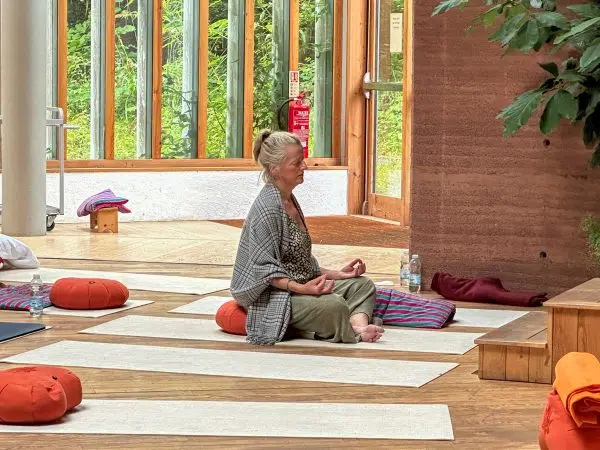
There are lots of postures available for meditation. Sometimes we have this image in our mind of being perfectly cross-legged, but it doesn’t necessarily mean that. David sometimes calls the place you practise your “meditation nest” – very cosy! It can be simple, so long as it feels comfortable and supportive. A cushion or an ordinary chair will do, and you can lie on your back if that suits you better. There should be no need for anyone to endure pain to meditate, so choose whatever lets you stay comfortable for the whole session.
Once you are settled, it can be nice to run your attention through the body. Let your shoulders drop, as though surrendering them to gravity. We often collect a lot of tension in our face, so soften your jaw and let your forehead feel spacious, so you’re not frowning. When the mind is anxious, the eyes can often feel hard, so it can help to soften them too. You can have your eyes closed, hooded or a little open, as you prefer.
Then let the spine lengthen gently, with the chin slightly tucked. It can help to raise the sternum just a little, so that on each in-breath the sensations travel easily down to the belly and you can feel it expand.
When the mind wanders
Lama Alan describes the first stage of training attention as one of movement everywhere, the body fidgeting and thoughts scattering, and he says that this is true for all of us. He borrows an image from the classic Tibetan teachings: thoughts can feel “like a cascading waterfall.”
The skill to develop is noticing, as soon as you can, that attention has moved away. Distraction is not a failure, and when you do notice, there is no need to tense up or get annoyed with yourself. David describes the response like this:
"The response here should be to relax just a little bit further, to loosen up, to release the grasping that we have around those distractions. To relax, to let go, to release and then gently return our attention. Avoid tightening, pushing, trying harder."
David Oromith
Pushing harder tends only to create more agitation. Thoughts will start up again after you let them go, and that is normal; you can no more stop them arising than you can stop sounds around you. So we don’t need to try.
Sometimes the mind goes the other way and turns dull, vacant, and sleepy. For this, some tightening of the mind and a bit more effort can help: open the eyes a little and raise your gaze, and make sure your posture is still upright and alert.
Lama Alan calls this a balancing act. The first part is learning to relax more and more deeply without falling asleep; the second is steadying the attention without losing that relaxation.
Why practise meditation?
The practice you have just tried is called shamatha: training the attention to become stable and clear while staying relaxed. Shamatha is always about balance, from the first session to the most refined stages. Our guide What is Shamatha Meditation? goes further, into the qualities we develop through shamatha and the stages we move through.
We so often look for happiness in the things outside of us – entertainment, busyness, objects, people. In this practice, as Lama Alan describes it, we explore another option, a serenity that comes from a balanced mind. In his experience, the more we cultivate our own inner resources, the more content we can be, with a growing sense of genuine wellbeing, while consuming very little.
We invite people to begin each session in a spirit of loving kindness, so that the session itself is an expression of loving concern for yourself and, implicitly, for everyone else. In the Buddhist tradition this calm, steady attention also then serves as a foundation for further practice, including insight and compassion practices.
Keeping it going
Lama Alan likens meditation to going to the gym. You wouldn’t come out of your first hour with a trainer and ask which part of you was better; you’d give it a month of regular exercise and then check perhaps. Meditation is rather similar. We suggest ten minutes a day to begin with, and giving it a month before you judge.
Meditation is generally safe, but if practice brings up strong anxiety or distressing memories, stop and open your eyes, and ground yourself in your surroundings. Talk to a teacher or a health professional before continuing, particularly if you have a history of trauma or a medical condition that affects your breathing.
Your next step with Samadhi
The simplest next step is to practise with us live, at our free weekly online meditation every Sunday. Between Sundays, our practice library has over a hundred guided meditations to try.
Frequently asked questions
Do I need to be a Buddhist to practise Buddhist meditation? No. David draws on Buddhist teaching alongside modern psychology, and he suggests using what helps and leaving the rest.
Can I meditate lying down? Yes, if that is more comfortable. There is nothing wrong with lying down to meditate. The Buddha suggested we try meditating sitting, walking, standing, and lying down. The main thing about lying down to meditate is to watch for sleepiness: the aim is to relax deeply while staying clear and awake.
Is this the same as mindfulness? It uses mindfulness: this practice is mindfulness of breathing. Mindfulness, the capacity to bear something in mind without forgetting, is a component of shamatha, but not the whole of it. Mindfulness of breathing comes from the Buddha’s own teaching, where it is given as a way of developing calm, focused attention. Our article Mindfulness vs meditation explains how the two relate.