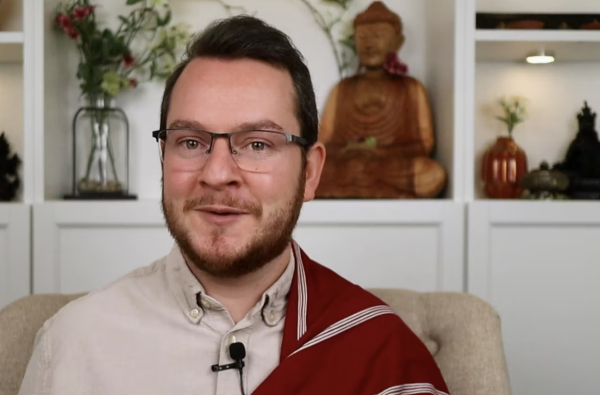
Sunday Meditation 4th May
David Oromith
Hello, hello, hello.
Good morning everyone. So wonderful to see you all and to get to spend this time with you. I hope you’ve all had a good couple of weeks since I may have last seen you for one of these Sunday sessions.
Meditation
(Settling mind and body)
Metta Bhavana meditation
And then to begin the classic loving kindness meditation:
I invite you to bring to mind yourself as you are here. And now
recognising that within us is something quite precious, something that we share with all sentient beings, something that has brought us to practice today.
And that is our innate desire, preference, wish: what we can broadly call happiness, which encompasses many different facets: love, peace, wellbeing, safety, comfort, connection.
So first of all, do you recognise this within you? How this moves you through life? And can you see it as something quite precious? And can we see how beneath every little movement towards pleasure and joy, there is something deeper that we’re looking for?
A lasting contentment of fulfilment, a genuine wellbeing. Now loving kindness very simply is the wish, the yearning that the individual you’re attending to be, will be happy, have this genuine wellbeing and its causes.
And so directing our attention towards ourself:
Can you arouse this wish, this yearning.
May I be well, may I be safe? May I be happy?
May I have genuine wellbeing and its causes.
And you might envision it: what would it look like for you to be genuinely happy, for you to flourish? What would that look like?
How would that change the way you approach others, your relationship with yourself?
How would you hold yourself? How would you walk? How would you talk?
Envision your own greatest fulfilment to your own flourishing, and then wish, may it be so
Next in this classic practice, we turn our attention to someone we care for very deeply: a friend, a loved one. We bring them to mind now, perhaps visualising them here with you, in the space next to you, in front of you. Imagine looking at this person now, knowing all that you know about them. How they too desire the same happiness, fulfilment, wellbeing, safety, comfort, and so on. Know, in our heart of hearts, beneath the layers of attachment and sometimes pettiness and other things, in our heart of hearts, what we want most for this person is to see them happy, to see them flourish, to see them well.
And so tap into that very natural wish and express it in whatever words are most meaningful for you:
May you be happy. May you be well, may you be safe.
May you have genuine happiness and wellbeing and its causes.
And again, you might envision it. How might that look for this person to be genuinely happy, genuinely well, and to have a lasting sense of fulfilment and contentment, peace in their lives. Bring forth that vision.
And then wish: May it be so, may you experience joy like you’ve never known. True happiness, true wellbeing.
Next, we turn our attention to the next category: the stranger or the neutral person, someone to whom there are no strong feelings either way. And so I invite you to think about someone towards whom there’s this sense of indifference. And this could be someone you know, or it could be a stranger that you’ve met in passing, you’ve walked by, seen on public transport, a distant neighbour.
And just noticing that sense of indifference. As we envision this person, we bring them to mind. And the one way we can connect with all sentient beings is the fact that we can know that this person too, looks
for the same thing, happiness, wellbeing, and so on. See if you can connect with that, with their own desire to be happy, to be well, to be safe. And allow that loving kindness that you aroused for yourself, your loved one. Allow that to grow and encompass this individual as well.
May you be well, may you be safe. May you be happy.
May you have genuine wellbeing and its causes.
May you have a sense of fulfilment, contentment.
May you have joy in your life.
Again, if you are quite a visual person, you could envision this. How might this look? And then wish them well: may it be so.
And then the final category, what is known as the ‘hostile’ category
or the enemy. Classically defined as someone who wishes you harm,
but could be anyone towards whom there’s some conflict, some disagreement, perhaps even just a sense of division, a sense of not seeing eye to eye or being connected, distance.
And if we’re newer to this practice, we try not to choose anything too traumatic or difficult, but someone we feel comfortable working with.
And again, bring this person to mind vividly in the space in front of you, next to you. And here too, can we recognise that this person also has this innate desire, happiness, wellbeing, joy, pleasure, comfort, safety.
And there may be behaviours which we find disagreeable, but they’re coming from the same place: A desire to be happy, to be free of suffering.
And it manifests itself through a vastly different upbringing, beliefs perhaps. And you cut through all the layers that divide you, that separate you, and get right to the core; and see a sentient being just like yourself. No different on that level. And see that we’re all equally deserving of, of finding the opportunities for genuine wellbeing in its causes. And as a concession, you might recognise that if this person
was genuinely happy and well fulfilled and content and had joy and love, they may not behave in those ways that you find disagreeable.
The world is made no more darker by one more person being well and happy. And so can you arouse this same sense of love and kindness, expanding it?
May you have genuine wellbeing in its causes.
May you be happy.
May you be safe.
May you be well.
And then again, if you like, you might envision what that would look like.
Not imposing anything on them, but imagining them having a sense of wellbeing, happiness, contentment, fulfilment. Imagine them truly well, and allow your heart to open and yearn for it.
May it be so
Then let us expand this out to each one of us, sharing this practice together, wishing that each one of us may find genuine wellbeing and happiness and its causes.
Extending this out to other loved ones, friends, family, acquaintances, and the sense of loving and kindness, expanding it above, below
and across to all sentient beings. Without exception, may all sentient beings know such wellbeing and joy and happiness.
Teachings
What I thought I could speak to this week as our theme, is something that has come up multiple times for me this week, actually, entirely coincidentally. And, and it is the power of the small acts of kindness in daily life.
And in the conversations that came up, one of the points that was mentioned, was just how much the news and the media really, obviously push a narrative that outrages us or upsets us,
with a lot of fear mongering and sensationalisation. And, and of course, they do that because people are often more triggered by negative news rather than positive news. It keeps them watching, keeps them engaged.
But the knock on effect is that our outlook over time, as we consume all that, whether it’s the hate and fear on social media, or whether it’s mainstream news and so on, the knock on effect, as we keep consuming that over time, is our outlook becomes more negative, we become more fearful, we become more hateful, more divided. We take that information and then it becomes real for us, right? But the media, of course, doesn’t present a balanced view. It’s the one view that’s going to keep you watching.
And so I’m not here to suggest that we pass the blame or that we judge either the creators or the consumers of these sort of things.What I am suggesting is that the world is actually a lot kinder, a lot nicer, and a lot more loving than social media and the news will give credit for. Yes, there’s division and we are living, you know, perhaps in an increasingly divided world; nothing’s perfect.
But, as these two conversations that I had this week have shown me, kindness is out there, small daily kindnesses: you know, there are people out there, helping others get on the bus, as one person mentioned, or holding the door open for someone, handing a hot drink
to someone on the street. Even just smiling at one another, greeting strangers.
There’s these small things that are happening daily, that if you’re out there, you can witness them, you can observe them, you can attend
to them, you can add to them. And the vast majority of these, these acts are done just spur of the moment, simply because they’re the right thing to do, right? They’re a nice thing to do. They’re an expression of the individual’s compassionate nature. They’re basic goodness, right?
They’re a common feeling with another human: that sense of connection.
So there’s all these small kindnesses and then the big kindnesses, of course: people who are volunteering their time, (as do a number of our community here), volunteering their time to a number of causes out there, that are working to benefit other humans, other sentient beings, our planet. So many people doing good work like this all over. In your area there are people probably working in charities and causes you don’t even know are there, let alone in the world at large. Again, many of which are just done selflessly without expectation of reward, just because it’s the right thing to do, it’s a good thing to do.
And so as I was having these conversations with a few different people, a few things came to mind, and I thought that maybe this could be a topic for our session.
And the first is: ‘noticing the good’. You know, given the negativity bias in the media and indeed in human beings, can we make it our mission this week- perhaps as we go about our daily life- to look out for, and notice, any small acts of kindness and actually focus on those and really be receptive to it, be attentive to it. And when it happens, when you notice it, let it light up your heart. Don’t let it just be a passive thing. But really, really feel into that kindness that you see.
Manu and I recently, when there was a lot of rain, we went for a walk somewhere and we got our car stuck. The car park was completely full
and everybody was parking on the verge and stuff. And we got our car stuck. As we were leaving, or trying to leave, some people in cars who were also leaving, got out to help and it needed quite a few people. It was maybe, you know, four or five people pushing in the end, alongside Manu. And it was muddy. People fell in it- as the car moved a little bit, got their hands dirty, but they kept helping. They kept pushing forward. And then people were getting tissues out the car to help clean each other up and everything at the end. Nobody had to stop, you know, they could have just carried on but they decided to stop and decided to help.
And it’s those sort of moments where it really does uplift you, right?
You feel that strong sense of connection. You feel the benefit of somebody’s kindness, somebody’s warmth, and it really uplifts you.
And so are there things that you can witness?
And if you’re not somebody who maybe gets out and about, maybe you are a bit of a hermit like me, or you have to stay at home. Can you look up real acts of kindness? You know, look up local charities that are out there and find out the good work that’s happening near you, or find charities that are doing work that resonates with you- maybe, you care about animal welfare and so on. Find sanctuaries and charities that are doing that sort of work; follow them on social media or sign up to their newsletters so that you can see their messages, you know, uplifting messages of the work that they’re doing, to help counteract perhaps any bias or any other information that we’re being fed.
And so the first thing I think, let us try to find the good, notice the good,
Then the second, of course, why don’t we do the good? Can we also engage in some of this. ‘Dana paramita’, one of the six perfections, for anybody following the Bodhisattva path. One small act of kindness each day could be a practical training in this, you know, just a little way to over time, as we do one little thing each day, we’ll naturally become kinder, more generous people, more naturally giving, and that will just become a part of who we are. And so, can we engage in these little ways? Whatever they are, however small.
And the final comment related to that is, that, at least for it to be dana paramita: the perfection of generosity, to practice generosity in the Buddhist context, often mentioned is the importance of letting go
of any expectation of reward or recognition, right? Of doing something simply because it’s the right thing to do. The act of giving in itself is complete by virtue of just wanting to help, wanting to be of benefit. It’s complete. Our own expectation of a reward or even appreciation can sometimes spoil our generosity.
I remember one of these sessions, somebody coming along,
(and this must have been a theme that week), they mentioned that they worked in a hospital and they would often hold the door open for people. And, in their sharing, they said, ‘You know what? I’m not gonna do that anymore. I’m not going to to help. I’m not going to do it. What’s the point?’
What they were saying was that, as they were holding the door open, there were a lot of people who were either not acknowledging him,
not saying thank you, and one person said to him, ‘I can hold the door open for myself, thank you very much’, in a kind of brash way.
And so he said, ‘I’m just not gonna do it anymore. What’s the point in being kind?’
And this is an example where the kindness, the generosity that we’re offering becomes spoiled by our expecting something in return; we should either get some praise or some recognition or something to make it worthwhile doing. But the beauty of giving is precisely letting go of the self-interest, isn’t it? Of giving freely without needing anything in return, that’s what makes it something really uplifting and warming and beneficial for ourselves and others.
And so can we notice the good? Can we do the good, making our perception of the world better and lighter? And then actively making the world around us better and lighter.