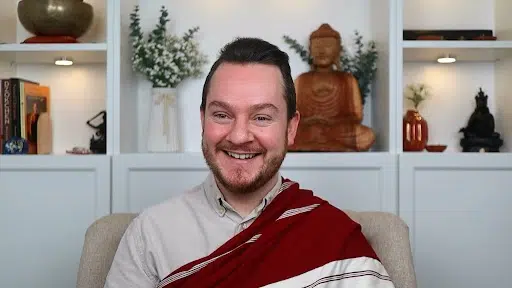
Sunday Morning Meditation February 1st
David Oromith
Hello, good morning everyone. Wonderful to see you all. Thank you for coming. Hope the week has been kind to you. So we’ll jump straight in as we always do. Meditation, then talk, then discussion. We’ll be practicing for about 20min.
Meditation
And so just taking a moment as we get comfortable. To bring to mind our most meaningful intention for this practices.
And then allowing your awareness now to descend into the body. Aware of the sensations in your body.
Aware of the sensations where your body makes contact with your seat. Aware of the rise and fall of the breath.
Aware of any other sensations: tinglings, vibrations, temperature – heat, cold.
And inviting your body to soften and relax from the top down, so really softening any tension in the face over clenching of the jaws, tightening of the eyebrows.
Releasing tension through the neck, the shoulders, loosening up the arms, in the hands.
And throughout the rest of the body. In your own time. Just invite in this sense of ease. Softening. Relaxation.
Only the body nice and relaxed. Allow it now to be still provided you are comfortable. Try to keep the body nice and still, no unnecessary movement, no fidgeting and keeping the body quite alert.
So if you are sitting, that means being upright, keeping the body vigilant, alert. That helps you mirror those qualities in your practice of being relaxed, being at ease, being still or stable in the practice, and being alert, vigilant
Before we venture any further in the practice. Really give yourself that permission mentally, now, to be at ease, to set aside anything that’s been on your mind, anything that’s been bothering you, any thoughts about the future, any thoughts about the past. Give yourself that permission that just for the short duration of this practice, you can set everything aside.
It’s okay to be at rest, to be at ease.
And so perhaps with a series of slow outbreaths, that there be that sense of release, relax both physically but mentally.
And with every outbreath. Now breathing naturally with every outbreath. Let there be a releasing of everything else. All the mental noise. Any mental chit, chat, ideas, plans, with each outbreath. See if you can cut the noise. Just release all of that.
And perhaps through the in breath it’s all going to start up again, the mind starts chatting, planning. Remembering that, with the next outbreath, just once again, release: release the noise, release the tension. Dropping everything else and coming to your present experience.
And what about your experience is the most fundamental, essential? If you go deeply into your current experience, setting aside anything that is not essential, anything that is temporary, anything that appears and disappears. Thoughts, memories, images, for example are always coming and going, so they cannot be essential, fundamental, primary.
Feelings and emotions can sometimes be quite shallow, sometimes they’re quite intense, prolonged, but they too are fleeting. They’re not always present. You don’t always feel one kind of way, so therefore they cannot be essential either. Go deeper than that.
Don’t overly think about this or complicate this. Just do the experiment as releasing everything else, in going experientially to the most fundamental, primary or essential aspect of your experience, not even naming it. What is right there at the core?
When you’re not focussed on a thought or a sound, a visual appearance, a sensation, what is left over? Is there any aspect of your experience that seems to be always present? You might be able to rest there for a short moment before the mind starts talking again: ‘Am I doing this right?’ ‘What’s happening?’ It gets distracted and that’s totally fine, that’s normal.
When you notice the mind has activated again, you are focussed again on thoughts, feelings, sensations, activities, memories and so on; we just release all of that- perhaps with the outbreath again – release all of the distraction. Come back to what is fundamental about your present experience always.
It is, of course, the experience of knowing or being aware.
And so see if you can experience that totally unmediated, unelaborated, that experience of being aware, knowing that you’re aware.
‘I’m not doing anything else’.
Recognise when your mind has drifted off into distraction. Then release all the noise, all the excess. The thoughts, feelings, sensations, perceptions. Release all of that. Come back to awareness itself and knowing that you’re aware.
And rather than thinking of this practice as doing something, it is actually one of profound inactivity. Thinking is doing, remembering is doing. Here you’re releasing all activity.
And in simply being aware, you know that you’re aware.
There’s nothing more to do other than to rest in the immediate experience of being aware. That which is at the core of your experience. Always.
Teachings
So for this morning’s, talk or topic, what I thought I could turn to is – some of you I know will already have the book- that is, all the messages are based upon these sessions, right? They’re all condensed versions of these talks, these topics.
There are a few in here that are new, that didn’t come from one of these sessions, but we were trying to put something else in, one of which is number sixteen, which I thought we can now bring into these sessions.
In the book, it’s called ‘I give you the Moon’ it’s a little story, a Zen story. And so I thought I’d share that story. And then perhaps that can lend itself to a discussion.
So it’s quite a well known story in Zen. And so I think the name usually is ‘The Thief and the Moon’ or something like that.
The story is about a Zen master by the name of Ryokan. And the story goes that he lives at the foot of a mountain. And he has a very simple life in a simple, undecorated hut. It’s made of weathered wood and a roof that’s made of dried grass. And this one particular evening, with the moon high and bright, Ryokan is out walking and a thief comes to rob his hut. The thief comes in ready to steal something, only to discover that there’s nothing really to steal. And the hut is actually quite sparse; it’s quite empty. And so while the thief is rummaging around trying to find something. Ryokan returns. and finds this stranger in his hut. So he catches him searching around, and he says, ‘You’ve come all this way to visit me. You really shouldn’t leave empty handed. Please take my clothes’. And so he takes off his robe, which is his only possession really, and he hands it over to the man. Now, the thief is completely bewildered, he’s a bit confused, and it’s a bit odd, and so he’s left speechless, but he takes the robe anyway, and he sneaks off.
And after the thief has gone deep into the trees. Ryokan sits down under the night sky, now completely naked. And he looks up at the moon and he says. ‘Poor fellow, I wish I could have given him this beautiful moon’.
And so it’s a very simple and short story or tale yet I think it’s really quite beautiful. And there’s a lot packed in there, actually, and so anything I’m going to say now is only going to spoil it. But as a way of opening into our discussion, perhaps I could share how I interpret this.
Of course, firstly, what we have is this Zen master who quite clearly has relinquished his attachment, and is brimming with compassion.
So in the story, there’s no surprise, no shock, or no kind of – he comes in, sees the thief, he’s trying to come to terms with that and figure out what he’s going to do next – there’s none of that.
There’s no judgment either, he doesn’t start judging. He just sees the man in his hut who’s clearly desperate, and immediately there is that sense of empathy- that’s the first thing isn’t it? It’s immediately that sense of empathy- ‘Gosh, you know I’m in the middle of nowhere’. Ryokan knows he lives in this hut, this off grid hut at the foot of a mountain, literally in the middle of nowhere. He knows that it would have been quite a journey to get to him.
And so that’s immediately what he thinks: ‘He must have come a long way. He’s searching for something, he’s looking for something. I can’t let him leave with without anything’.
And so he’s immediately thinking of the other, isn’t he? Not the self. And so he offers what little he has. Why is he able to do that and not just say, ‘Well, you know, I’ve got nothing for you, because the clothes are the thing on my back, you know? So I’ve got nothing. I’ve got no possessions’. Why is that not as responsible? The way I interpret it, at least, is that it’s because he’s free: he’s free from craving; he’s free from attachment; he’s free from a sense of scarcity or a fear of being take taken advantage of. None of that is a concern. He’s free enough from that kind of self reference, any self centredness isn’t he?
And because he’s free of that, he’s free to be able to feel empathy and compassion for this man. Those kind of things would get in the way, right? If you had a sense of scarcity or you had a fear of being taken advantage of or an attachment to your possessions or a craving or any of that, those would get in the way.
But because he’s free of all of that then he’s free to feel empathy and compassion for this man who’s trying to steal from him: to be able to recognise what is going on for him. ‘This man, he must be impoverished. Or maybe he’s being pressured into this, or maybe he’s stealing to support his family, or maybe he just enjoys stealing’. Who knows, right?
But whatever his reasoning is, why do we as humans do what we do as sentient beings? All of us- why do what we do? This man is out here desperately looking for something. Searching for something for his livelihood, something for his well being, something for gratification. Who knows? To improve his life in some way. He’s looking for something that’ll make his situation better.
And more… he’s looking for happiness, isn’t he? In a very basic sense, he’s searching for happiness and the causes of happiness. Something that will make him happy, will make him well. And aren’t we all looking for happiness in our own ways? Every day, everything we do, trying to improve our situation in some way, trying to make it better, trying to just get through, make ourselves happy in some way.
That’s what we’re all doing. And so Ryokan immediately recognises that because he knows that himself: he’s a human, he knows what that experience is like. But right now he’s not caught up in his own sense of self- ‘Me, my possessions’. He’s free enough to see and understand and have empathy and compassion, free enough to give up his only real possession.
If it might benefit another. Then want them to have it. And then not feel bitter or regretful afterwards. You know, he might find some sort of covering tomorrow. Who knows? No big deal. But right now, here’s someone who needs something.
And yet, even after the man has left, he still feels for him. And he wishes that the man could have what he really has. The clothes that he had was not his real wealth, was it? And so what he really has is not a possession – at least the way I interpret it – it’s the space and the peace of mind to be able to enjoy the moon. To be able to enjoy that and see the beauty and have that sense of awe and calm, because is that not really what the man is searching for? He’s searching for happiness, right? He probably would appreciate peace of mind, to feel well, to feel good, to feel at peace, to feel content, to feel okay with oneself, to feel love and joy and lightness. Wouldn’t we all like a bit more of that in our lives?
And that, for me, I think, is what Ryokan, looking up at this beautiful moon represents: all of those qualities of peace and love and contentment and joy and so on. And so I think, as I wrote in the reflection in the book, this is where Ryokan’s real wealth lies, right? This is where it lies. He’s not externally wealthy by no stretch of the imagination, but internally he has all the wealth one could look for: unshakable well being and joy and compassion. And I think I ended it with, sadly here for the thief, that kind of wealth can’t be stolen. You can’t steal someone’s peace of mind, their joy, their well being.
But sadly for the Zen master, sadly for Ryokan, he could not give that away. You can’t just give someone your peace of mind, your joy, your well being either. And so for me, it’s kind of a wistful story, in a way, if that’s the right word; there’s a kind of a tinge of sadness to it. It’s sad for both individuals. The thief cannot take what makes Ryokan so happy and well, and Ryokan, as much as he wished he could, as much as his compassion is strong, he cannot just give the man his well being and happiness either. He has to find that for himself.
So that’s what I get out of this story, this little tale. Perhaps we could think about, what might it look like to turn towards the moon instead in our own lives, you know, because we’re a little bit like this thief, in a sense, not stealing from people, but looking for things in all sorts of ways.
But what would it look like to turn towards the moon?